What if relationships just aren't for me?
Together with a psychologist, we look at dating fatigue, disappointment in love, and when they pass.
What if relationships just aren't for me?
What if relationships just aren't for me?
If I'm myself, will anyone choose me?
Together with a psychologist and lecturer at the Smart Institute, we look at dating fatigue, disappointment in love, and when they pass.

I feel disappointed in love. I'm now at the age I used to imagine as my "happily ever after" years, but in reality there are only pointless dates, dating fatigue and the thought:
"What if relationships just aren't for me?"
A psychologist answers
Smart Institute of Psychology × Purpur
What is modern dating really about?
Let's be honest: modern dating isn't a search for love but a tense race for the "perfect partner" in a world where an excess of options turns people into profiles on a screen rather than living, whole individuals.
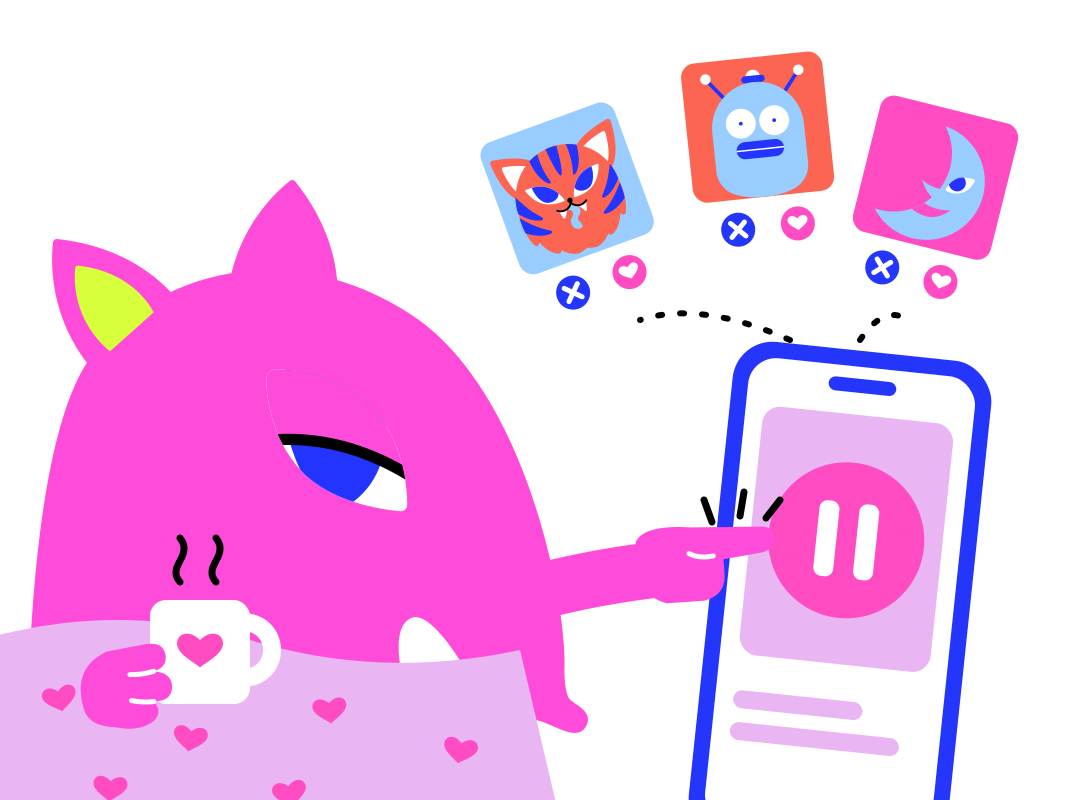
We scroll through people like a product feed in an online store, where the "product" has to match a list of requirements. The paradox of choice: the more options there are, the harder it is to choose, and the higher the anxiety that you've missed "the best one". After a date, you don't think about the warmth, but: "What if the next one is more interesting?" Dating becomes a testing ground for self-criticism rather than a space for discovery.
Being a ~~better~~ different version of yourself
Dates often turn into a performance: you show a polished version of yourself and lose your real "self". When the date ends, it hurts not because you were incompatible, but because you spent your energy on seeming rather than being. You're left with the question:
"If I'm myself, will anyone choose me?"
This isn't weakness. It's structural fatigue from a system where closeness is a transaction:
"I give attention, you give validation"
A failed exchange feels like rejection, when in fact you, as a "product", simply didn't match their requirements either, and they aren't ready to step outside the frame of modern dating either.
Disappointment isn't the end, it's a turning point
We're not disappointed in love, but in the illusion that the person beside us should be ideal: they'll understand without words, never hurt us, make life "complete". But real people come with fears, traumas and unfinished business. This isn't failure. It's a call to move from the romantic ideal of childhood to a more grown-up understanding of love, where we choose the whole person, where give and take are in balance, and where we both stay with each other not because of perfection, fear or obligation.
"What if relationships just aren't for me?"
This question is a sign of fatigue, not a diagnosis. It comes up after a string of dates where you felt invisible. But it's important to tell the difference:
Healthy autonomy:
you value being alone; relationships are an addition to life, not its meaning.
Protective withdrawal:
stepping away not out of freedom, but from the pain of repeated disappointments.
The second state is understandable, but don't mistake it for a final answer.
What to do?
Give yourself a pause: not "forever", but "for now". Until the pain passes, until your curiosity about people as individuals, not as partners, comes back. Until you realize:
"I don't need someone to be whole. But I'm interested in sharing my life with another person."
Love isn't about searching for the perfect one. It begins when you put down the magnifying glass, stop looking for flaws in yourself and your partner, and let both of you be imperfect. Your fatigue isn't a rejection of love. It's a rejection of pretense.
Take a pause.
Reclaim your right to simply be, without filters, scripts or the fear of "not making the cut". Then you'll be able to accept another person as they really are, too, and let them be with you as their true selves, without masks, demands or attempts to change them.
Because only when we stop being afraid of seeming "imperfect" does a relationship make room for something real: for warmth that doesn't depend on judgment, and for closeness built not on how things should be, but on how they are.