I'm sick of my partner
If we feel this way about a partner, does it mean love is over?
I'm sick of my partner
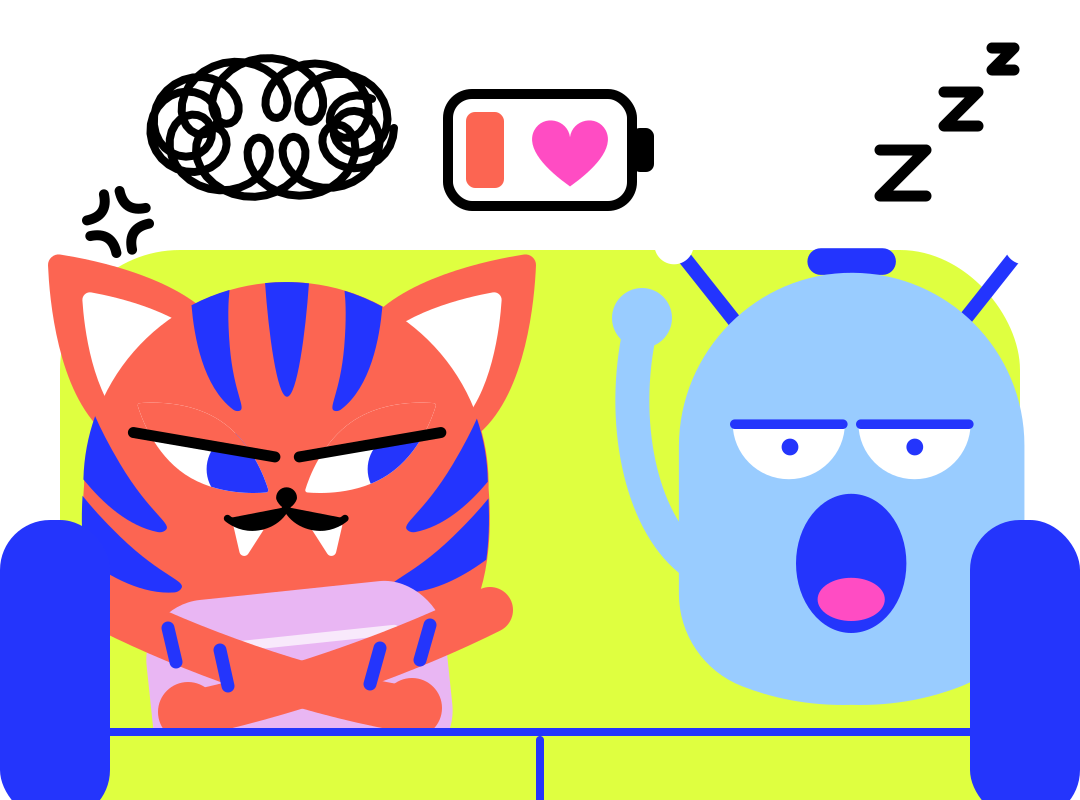

"I've gotten bored with you," "You really get on my nerves" — does that sound like the end of a relationship or the start of a new stage?
We look at why, as we grow closer to a partner, we feel boredom, anxiety and irritation. And we keep repeating: emotions are our important allies.
Do you ever feel bored in a relationship?
If we feel this way about a partner, does it mean love is over?
A psychologist at a counselling centre explains
Have you noticed that as you grow closer to a partner, besides being in love, completely different feelings start to show up too: boredom, anxiety, irritation?
Why does this happen? Let's look at how it works on the level of biological mechanisms, social attitudes and psychological needs.
Dopamine waves
At the start of a relationship, our bodies release waves of dopamine — a brain chemical and hormone associated with feeling pleasure. It's released in anticipation of pleasure, usually when something is still new and unknown to us.
So a new relationship is in itself a reinforcement for releasing that very dopamine — you don't need to do anything special for it.
Over time, the hormonal response to a partner naturally changes. And that's what can be mistaken for boredom. Because now, to get a dopamine boost, you need to come up with ways to spend quality time together.
Everyone's ideal relationship is different
Most of us grow up with idealized ideas about how relationships work. Neither at school nor in the family is there much conversation about how to build and develop a relationship. I mean, there is talk about family being important, but nobody talks about how to build one. And in movies, relationships magically fall into place on their own — all you have to do is find "the one."
So in adult life, partners come together with some formed desires, but almost always with zero idea of how to build the relationship they want. And we also rarely talk through our expectations of the relationship at the start.
This is where a lot of tension arises. For example, the belief that our partner should understand us without words, or not understanding what exactly you want from the partnership, can cause irritation and other difficult feelings.
Emotions are our allies
In many families of our parents' generation, showing emotions in front of children wasn't the done thing. So many of us never learned how to express emotions in a healthy way to resolve conflicts.
Yet when building a relationship, conflicts are inevitable. And it's completely normal that different feelings can come up in response to a stressful situation. After all, emotions are our signaling system, helping us adjust the settings so that we feel comfortable in our lives and relationships.
It's important to see emotions as allies. But if we didn't get that experience in childhood, there's a high risk that the relationship will fall apart instead of moving to a better level.
Nobody's perfect
We all have traits that we ourselves don't like, or that others may find unpleasant.
At the same time, we have a vital need for love and unconditional acceptance — that is, being accepted as a whole.
Attachment theory tells us: the closer we become in a relationship, the more we can relax and show our partner not just our best side, but also our darker, often especially vulnerable sides.
Difficult feelings showing up as you grow closer in a relationship is normal. It's an important signal that your relationship is moving to a new, deeper level.
And it's a great moment to check in with yourself: am I ready to face these difficult, often unpleasant feelings — which will definitely come up — for the sake of a relationship with this particular person?
And if the answer is yes, that's where a new, challenging, but very interesting and deeper chapter of the relationship begins.