The online version of you, and why rejection is easier to handle online
Our online barriers, constructed images and thumbs-up without context.
The online version of you, and why rejection is easier to handle online
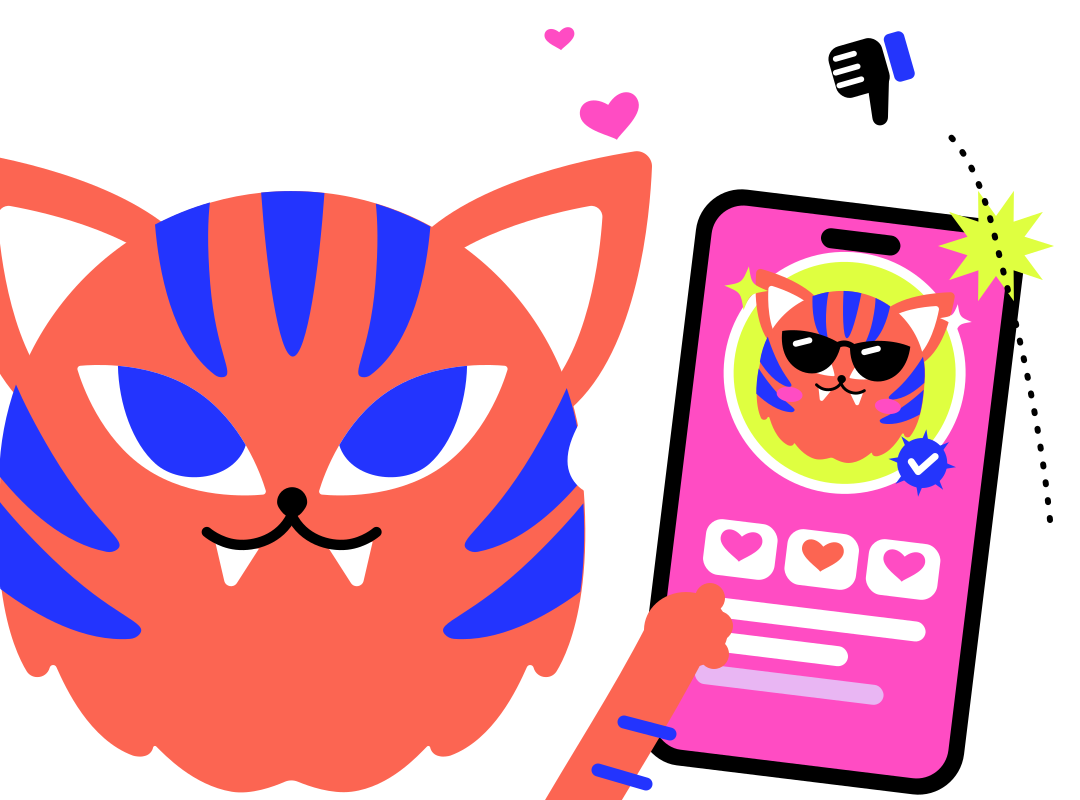
Our online barriers, constructed images and thumbs-up without context.
Purpur, a shop and media outlet about sex and relationships, asked a psychoanalytic psychologist and Telegram channel author to dig into the depths of our online selves.
The online version of you
Do our profiles reflect who we really are, or are they just an artificially created image? On the whole, there's no contradiction here.
Our social media is a constructed, idealized image of ourselves, a projection of our self that we fully control.
Even if this image has a lot of pretense and mystery in it, it still reflects our ideas about who we want to be, or who we think we already are. So either way, our online versions say something about us.
Why is it easier to speak openly online?
1. The barrier
When we talk to another person online, we don't give ourselves over completely. We're covered and protected by the image we've created.
Between us there's not only a screen and distance, but also some version of ourselves that creates an extra barrier. That's why the wounds we get from intimacy online feel less painful. We become less vulnerable.
2. Time is on your side
Has it ever happened that a bold, witty comeback to someone who was rude to you only came to mind a day later? In texting, this problem is solved. You can always put the conversation on pause and come back once the right words have come to you.
You can stretch out a difficult conversation, pull away when the closeness starts to feel unbearable — all of this lets you feel you're in controlled conditions, with the freedom to choose.
On top of that, we can always pair a hard conversation with pleasant activities, which eases the emotional load. Put a record on in the background and pet the dog — and somehow it's already easier.
3. Context
In online communication we often lack context. Did he just send a thumbs-up post-ironically, passive-aggressively, or is he actually happy for me?
At the same time, this is a downside that keeps us from fully understanding the message. But when it comes to difficult conversations, it lowers the intensity of the negative emotions we experience. A gesture, a look, facial expressions, the position of the hands — all of this can add drama to the simplest words, and when we're deprived of nonverbal language, what's left is drier, more factual communication.
What about online dating?
Dating apps create a sense of huge, sometimes even endless choice. The process of choosing a partner is easier in itself than offline. It feels like "somewhere out there, in this myriad of profiles, is exactly the person who's right for me." But there are so many candidates that over time it starts to cause fatigue and oversaturation. Rejection, being unmatched, an ignored message — it's all just routine and isn't taken as a personal insult.
And it becomes hard for us to see, behind every profile, a person who might spend the whole day wondering why you're not replying to them.
What else is easier online?
Besides intimacy, in the online space it can be easier to express yourself and share your experience. By choosing the timing and the format, we become ready for feedback, whereas in real life it can hit us right in the face.
Self-expression can also be targeted, when we're sure our interests match those of our audience. It's harder to read your Twilight fanfic out loud at school than to share it in the EDWARD TEAM Facebook group.
Distance, a constructed image of ourselves, choosing the moment and the format, a light touch of anonymity (delete your profile and never be online again) — all of this lets us open up on the internet and do things that in real life would take us more time.
All of this makes for a great space to explore yourself. Explore, and remember basic cybersecurity.